

October 1, 2026
Michigan Vineyards Cut Crop Loss, Labor, and Netting Costs with AVIX Autonomic Lasers
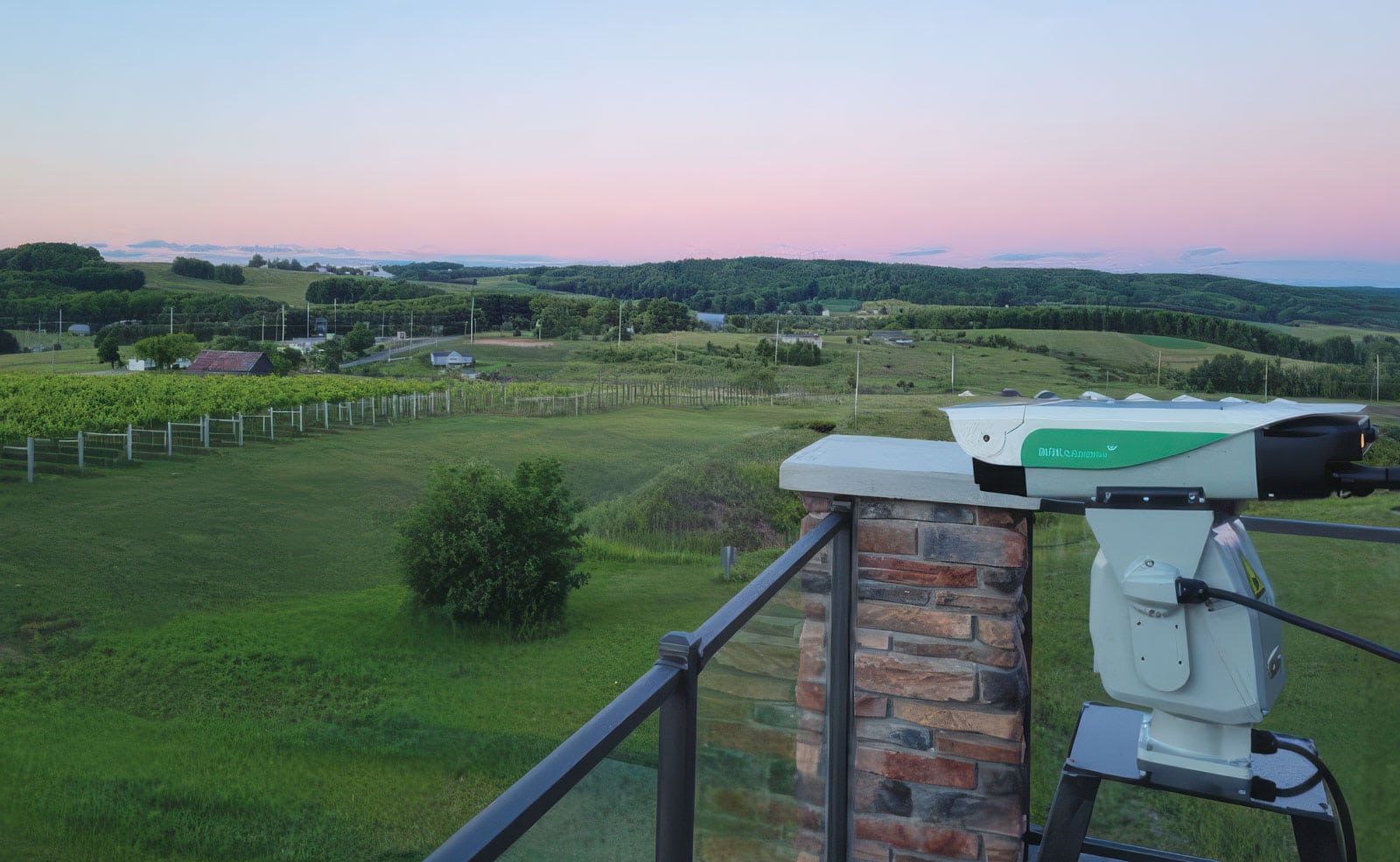
In northern Michigan, starlings become a serious problem for vineyards as the grapes begin to ripen. As sugar levels increase, large flocks can move into the vineyards and cause significant damage in a short amount of time. For many growers, netting has traditionally been the main way to protect the crop. While effective, it can also be costly and labor-intensive to install, remove, and maintain.
That was the challenge facing Petoskey Farms Winery and Hawthorne Vineyards. As reported in the September 2026 issue of *Wine Business Monthly*, both northern Michigan vineyards have replaced much of their traditional netting with AVIX Autonomic laser bird deterrents.
The systems were installed and programmed by Wild Goose Chase, a Bird Control Group partner. Their team of bird biologists and technicians works with each vineyard to determine where the systems should be placed and how they should be programmed based on the site, the crop, and the bird species causing the damage.
Part 1: Petoskey Farms Winery – Solving a Labor Problem
Location | Petoskey, Michigan, USA |
| Application context | 10 planted acres on a 20-acre vineyard (cold-hardy hybrids: Marquette, Petite Pearl, Itasca, La Crescent) |
| Problem definition | Yield losses due to bird damage; labor-intensive netting |
| Bird species | Starlings |
| Bird behavior | Foraging; staging on power lines along the property |
| Laser projection area | Approx. 10 acres |
| Number of systems | 2 x AVIX Autonomic (installed 2021) |
| Crop loss after installation | From approx. 30% to 5–15% |
| Annual savings | Over $100,000 in output earnings |
| Time of year with bird presence | Early summer—October |
| Time of day with bird presence | Sunrise–Sunset |
From 30% crop loss and days of netting to a half-day installation and over $100,000 saved every year
The challenge
Andrew and Tracie Roush planted Petoskey Farms in 2013. Bird pressure was severe from the start. Power lines along the property gave starlings a nearby place to gather before moving into the vines.
They tried kites and streamers, but neither worked well enough. With residential neighbors nearby, propane cannons and distress calls were not an option.
Netting reduced the damage but did not stop it. Starlings landed on top of the nets and found gaps along the edges. The vineyard was still losing around 30% of its fruit.
The labor was another issue. Four people needed several days to install the nets during the busiest part of the season, and the same process had to be repeated at harvest.
The solution
After seeing a laser demonstration at a neighboring vineyard, Andrew decided to give the technology a try, despite some initial skepticism. In 2021, Wild Goose Chase installed two AVIX Autonomic systems at Petoskey Farms, each covering approximately five acres. One is mounted on a raised structure, allowing the laser to sweep across the open fields without obstructions.

A Wild Goose Chase technician installs and programs an automated laser deterrent at Hawthorne Vineyards.
Source: Practical Winery & Vineyard Journal – September 2026
A Wild Goose Chase technician installs and programs an automated laser deterrent at Hawthorne Vineyards.
Source: Practical Winery & Vineyard Journal – September 2026
The results
After the lasers were installed, crop loss fell from roughly 30% to 5–15% per year. Based on Petoskey Farms’ output, Andrew estimates that this translates to more than $100,000 in additional earnings each year.
The difference in labor was just as significant. Installing both laser systems each season takes two people about half a day, compared with several days for a four-person crew to install the netting. The lasers go up in early summer, operate automatically from dawn to dusk, and come down after harvest in October.
Netting is now limited to 10 rows directly beneath the power lines, reducing the workload considerably.
More than three seasons later, Andrew continues to see the system working under heavy bird pressure. He has watched flocks approach the vineyard, encounter the laser, and take off rather than settle in the vines.
Part 2: Hawthorne Vineyards – Rethinking Material Costs
| Location | Traverse City, Michigan, USA |
| Application context | 27 planted acres on an 80-acre property overlooking Grand Traverse Bay (Riesling, Chardonnay, Pinot Blanc) |
| Problem definition | Yield losses due to bird damage; high netting material, labor and storage costs |
| Bird species | Starlings, Crows |
| Bird behavior | Foraging in sequence: crows arrive first, starlings follow |
| Laser projection area | Approx. half of the property |
| Number of systems | 1 x AVIX Autonomic, solar-powered, on a 24-ft pole (installed July 2022) |
| Results after installation | Lower crop loss than with netting; no habituation observed |
| Installation time | From 3+ days with 5–10 people to half a day with 1 person |
| Time of year with bird presence | July – harvest |
| Time of day with bird presence | Sunrise – Sunset |
One laser replaces a 10-person netting crew and pushes birds off the property
The challenge
At Hawthorne Vineyards, bird pressure followed a familiar pattern. Crows arrived first, and starlings often followed, using their presence as a signal that food was available. Once the birds entered the vineyard, damage could happen quickly. In some years, an entire vine row was lost before the nets could even be installed.
Protecting the entire vineyard with netting required a crew of up to 10 people and three or more days of work in August. The nets then had to be removed in November, as winter approached.
The cost added up quickly. Netting cost approximately $1,000–$1,200 per acre. Storage was another challenge: each acre required roughly two miles of netting, which had to be rolled onto PVC pipes and stored throughout the winter.
The solution
Vineyard manager Peter Rigan had known about laser bird deterrence for years, but adding another expense while the existing netting was still in place was difficult to justify.
That changed as the nets reached the end of their useful life. Instead of replacing the full system, Hawthorne Vineyards tested a different approach.
In July 2022, Wild Goose Chase installed a solar-powered AVIX Autonomic on a 24-foot pole, giving the laser a clear vantage point across the vineyard. Today, that single system protects approximately half of the property.
Netting remains only where the laser cannot reach, including the hillier sections and blocks near the wood line, where physical barriers are still needed to keep deer out.
The results
Installation went from three days with a crew of five to ten people to about half a day with one person.
“That is a meaningful shift.” — Peter Rigan, Vineyard Manager, Hawthorne Vineyards
Since the installation, Rigan has not observed habituation. He has also seen lower crop loss with a single laser than he experienced with netting.
Each season, Rigan reinstalls the laser in July, before the starlings begin flocking heavily and while the grapes are still developing sugar. It runs from sunrise to sunset through harvest.
Rigan has found that timing matters. In his experience, keeping the birds away before they begin feeding helps prevent them from establishing a feeding pattern in the vineyard.
Why the right laser and the right programming matter
Not every laser bird deterrent delivers the same results. Range, beam quality, and system setup all affect how the technology performs in the field.
Programming matters, too. The beam needs to move at the right speed and follow patterns suited to the bird species and site. Poorly designed coverage can leave gaps that birds learn to exploit.
This is where field expertise plays an important role. Their specialists assess each vineyard individually and program the AVIX Autonomic systems around the site’s layout, bird pressure, and operating conditions.
The systems are also designed for long-term seasonal use. AVIX Autonomic is covered by a warranty of up to 5,000 hours of use or two years from purchase. Because vineyards typically operate the systems during daylight hours rather than continuously, the same system can be used across multiple growing seasons.
This story is based on “Lasers in the Vineyard: A Smarter Approach to Bird Pressure” by Van Hoang of Wild Goose Chase/Migratory Bird Management, published in the September 2026 issue of Wine Business Monthly (Practical Winery & Vineyard Journal section), pp. 42–44. Our thanks to Wine Business Monthly, Wild Goose Chase, and to Petoskey Farms Winery and Hawthorne Vineyards for sharing their experience.
Bird Control Group’s automated laser bird repellent provides 24/7 protection from wild birds by shining a green laser light in the area affected by the problem. Get in touch via the form below if you are interested in learning more.
Solve my bird problem

